
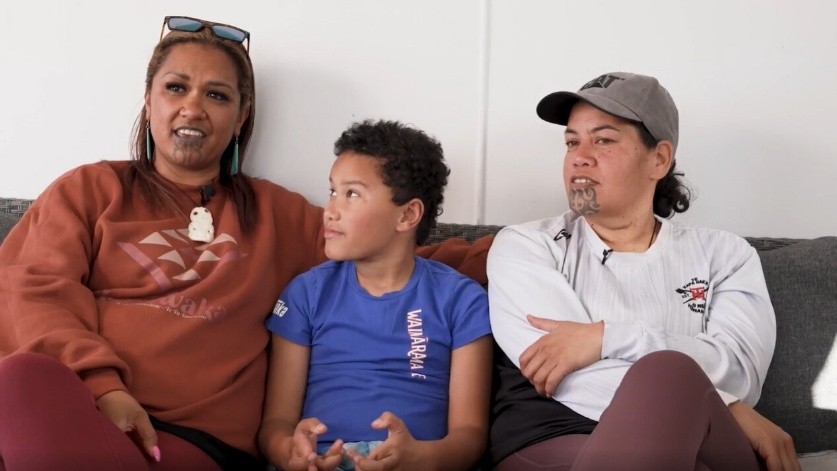
In the quiet beauty of Waimarama, on the eastern coast of Hawke’s Bay, sits a small pā immersed in whakapapa, whenua and whānau. It’s home to the hapū of Ngāti Kurukuru, Ngāti Whakaiti, Ngāti Hikatoa and Ngāti Urakiterangi, and it’s where Mischelle (Misch), Manawanui and their tamaiti, Te Auōhia Tohu-Tutengaehe, have built a life deeply connected to their identity and land.
For Misch, returning to Waimarama wasn’t just a choice, it was a calling. Growing up, Misch experienced a sense of disconnection from her own identity, moving between 17 different schools, unsure of her reo, and feeling adrift from her Ngāpuhi and Kahungunu roots.
“I didn’t know how to speak te reo Māori until I was 20. I want my babies to have something I never had, to know exactly who they are, where they’re from, and speak their reo.”
Waimarama offered that chance. Nestled among the hills and sea spray, the whānau live independently, embracing a lifestyle grounded in simplicity and sustainability.
“There are no bills, no major costs, just food and petrol,” says Manawanui.
Living in the quiet beauty of Waimarama
Photo: Misch Tohu, Te Auōhia Tohu-Tutengaehe and Manawanui Mihaere
Over time, they’ll begun growing kai, learning to fish, and adapting to a self-sufficient rhythm that feels worlds away from the city.
For Te Auōhia, this environment is a playground of learning, showing visitors his home, his kuri, and the whenua that shapes his everyday world.
While the whenua offered grounding, schooling options were not as accessible.
The nearest kura kaupapa was simply too far, and attempts to establish a rumaki or bilingual class at Waimarama School were met with challenges and community pushback.
“We were really keen to set up rumaki reo or even a bilingual class, but there were too many barriers,” says Misch.
Even attendance at Te Kura Kaupapa Māori o Arahou required long travel hours, which quickly became unsustainable. The whānau decided that home would be the best classroom.
“So, the idea was for him to remain at home, I will teach him, we both will,” says Manawanui.
“That’s when we looked at Te Aho o Te Kura Pounamu.”
Te Auōhia attending an online class with Te Kura
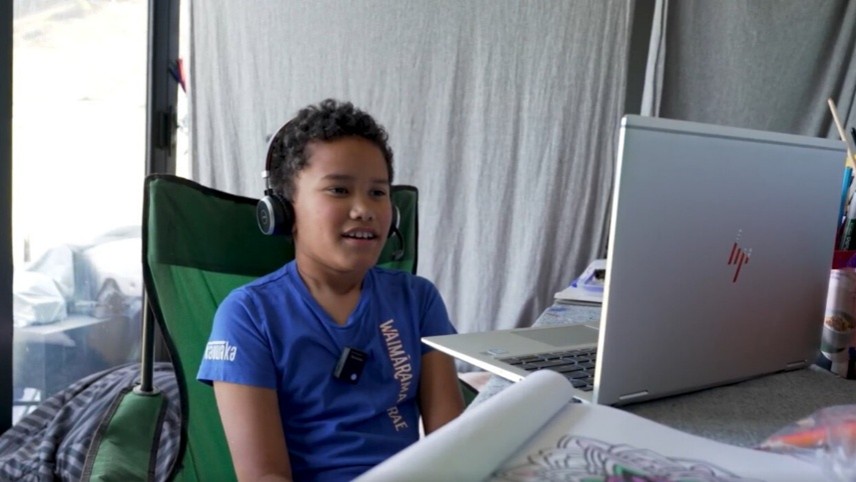
Through Te Kura, learning now happens across two whānau homes, especially with his dad’s side. This flexibility has strengthened whanaungatanga in ways the whānau didn’t expect.
“It’s good for the whole whānau,” says Misch. “He gets to visit everyone and do his schoolwork wherever he is.”
Since beginning his learning journey with Te Kura, Te Auōhia has blossomed.
His parents have noticed huge shifts in his confidence, social skills and sense of belonging.
“His relationships with children, adults, everyone are better now. He’s not so shy anymore,” says Misch. “He’s no longer hesitant, it surprised us.”
Manawanui agrees.
“He really developed in this world of home schooling.”
At the heart of everything is a simple but powerful aspiration, that Te Auōhia grows up grounded, confident, and proud of who he is.
As Misch puts it:
“Kei noho wawata noa kia eke. Don’t let it just be a dream, rise, rise above.”
In Waimarama, surrounded by whenua and whānau, Te Auōhia is doing exactly that.